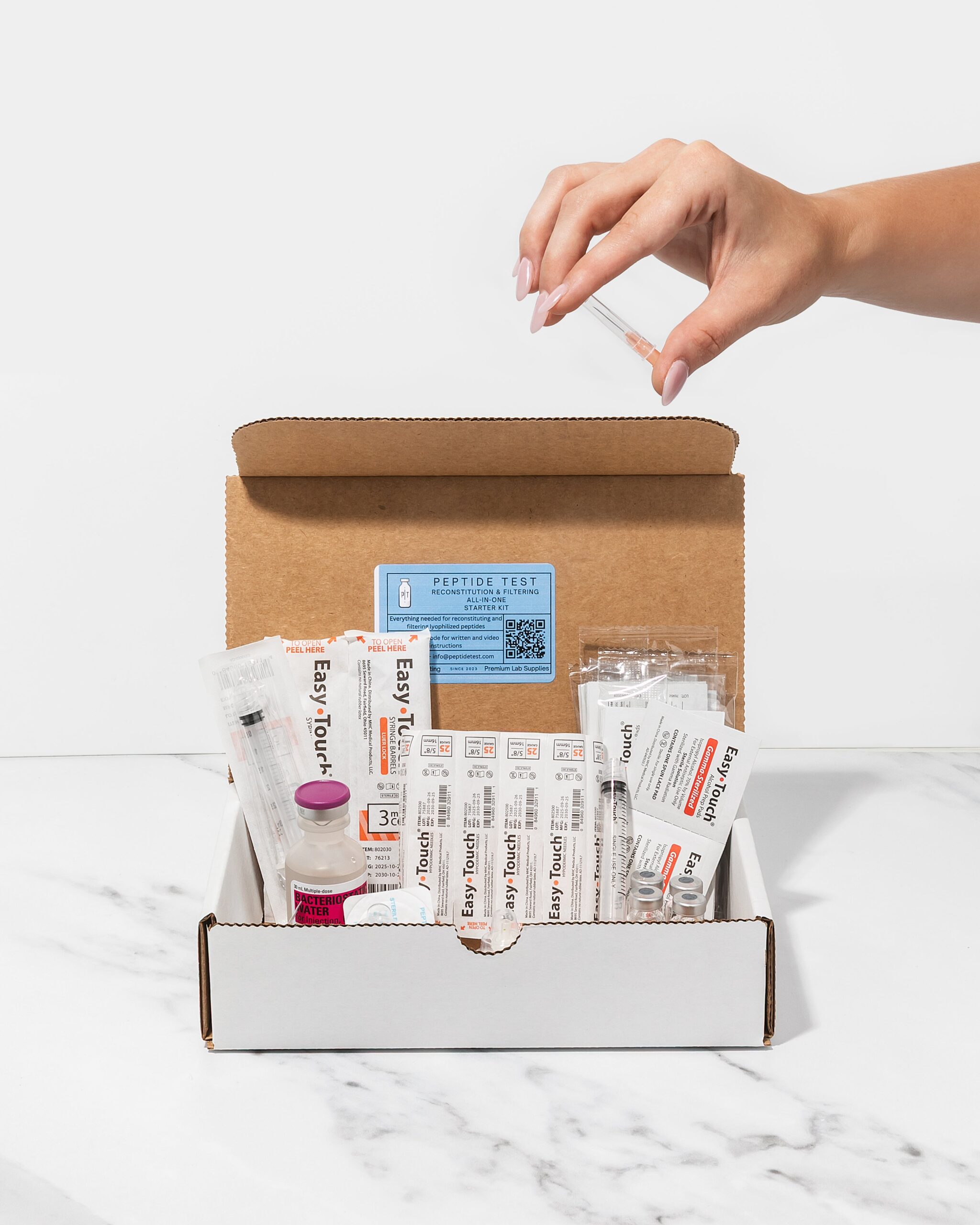
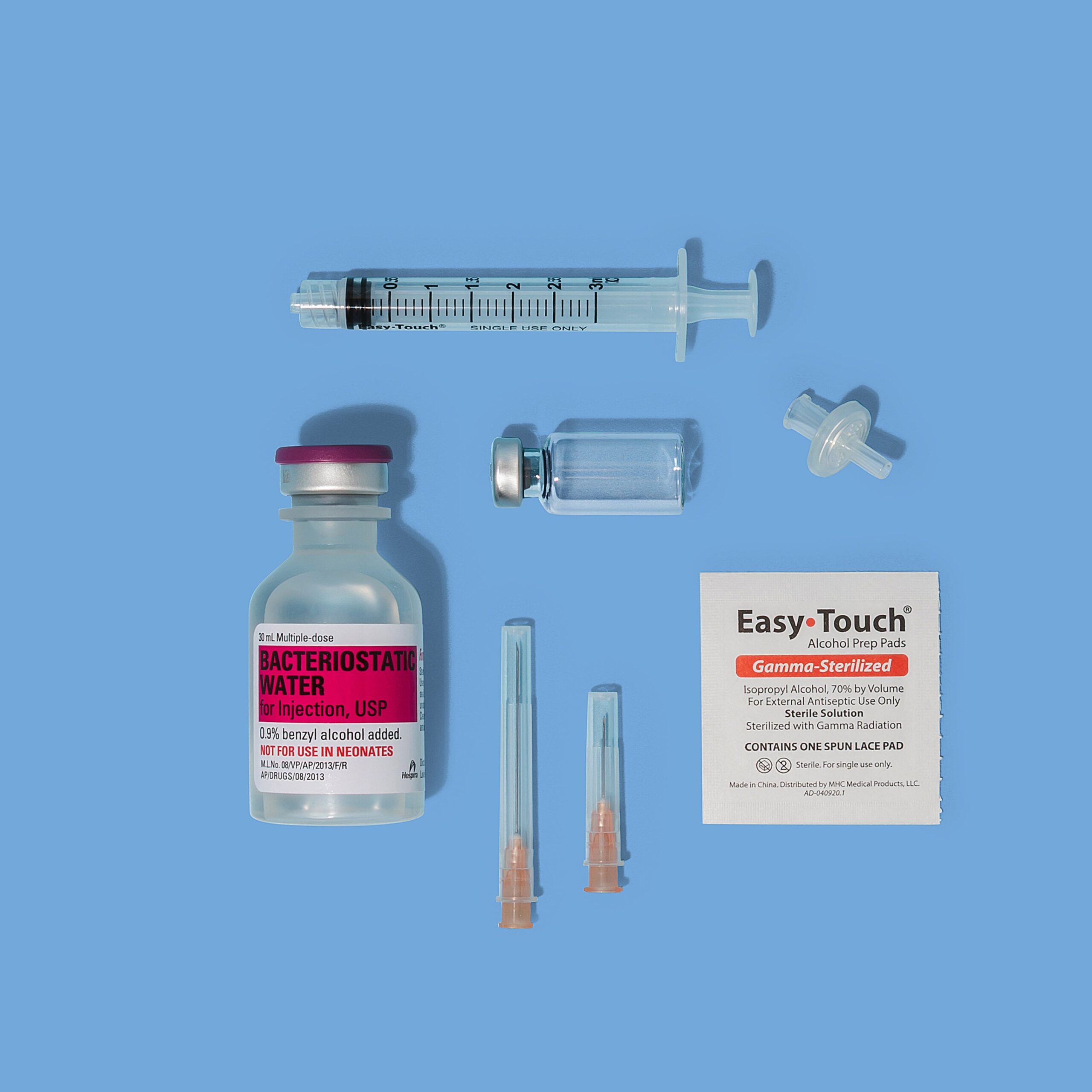
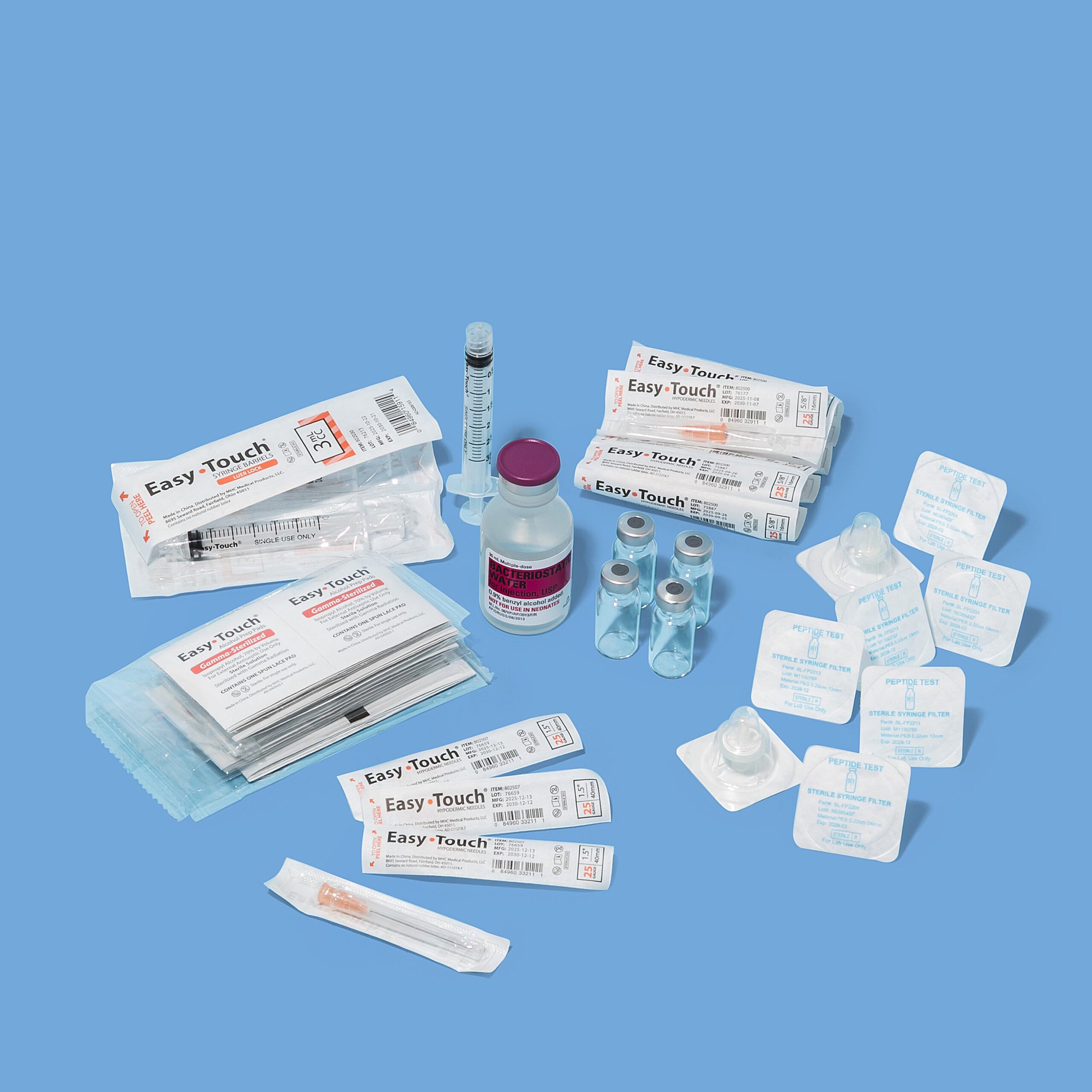
Contenido del kit:
Toallitas impregnadas en alcohol (pack de 50):
Toallitas estériles envueltas individualmente y saturadas con alcohol isopropílico al 70 %, ideales para desinfectar superficies y mantener condiciones asépticas.
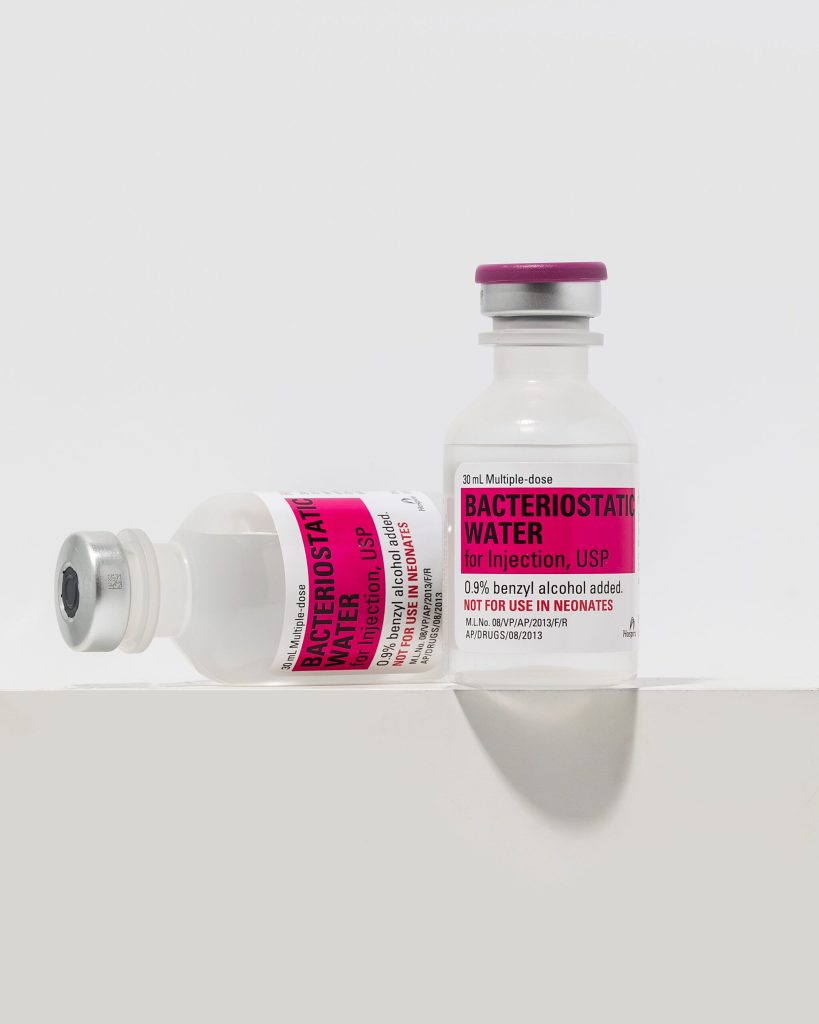
Agua bacteriostática – Vial de 30 ml (1):
Un vial de 30 ml de agua bacteriostática Hospira
Viales estériles de 3 mL (4):
Viales estériles con una capacidad de 3 mL.
-Nota: Los viales transparentes pueden sustituirse por viales ámbar si las existencias son limitadas.
Jeringas Luer Lock de 3 ml (4):
Jeringas luer lock de 3 mL de alta calidad, diseñadas para una medición precisa y una fijación segura de la aguja.
Filtro de jeringa PeptideTest 0,22 μm PES 4 mm (4):
Diseñado para una filtración de precisión y un rendimiento fiable, el filtro de jeringa PeptideTest 0,22 μm PES 4 mm ofrece una purificación de alta eficiencia en un formato compacto de bajo volumen residual, ideal para volúmenes pequeños.
Filtro de jeringa PeptideTest 0,22 μm PES 13 mm (4):
Proporcionamos estos para ventilación, pero dado que tienen una superficie mayor, también pueden utilizarse para una filtración eficiente, en cuyo caso puede usar los filtros de 4 mm para la ventilación
Agujas hipodérmicas 25g 1-1/2″ (4):
Agujas estériles de calibre 25 con una longitud de 1,5 pulgadas
Agujas hipodérmicas 25g 5/8″ (12):
Agujas estériles de calibre 25 con una longitud de 5/8 de pulgada
Todd Tenhet –
Better put together than expected
C.J. –
Everything was neatly packaged and of great quality! It was like a Christmas present to myself #nerdingout
Stevie Porter –
Great kit. Very helpful and has everything you need. I will definitely be purchasing again due to the great medical quality standards this is packaged with.
John Sani –
Had everything I needed to filter for my first time. Now I know what I need and ordered bulk. Love this kit!
joe Johnson Johnson –
Overall very satisfied. All quality parts and materials. Everything fits as it should, no issue with quality or use.
Only one negative, and that is the fact that the bacteriostatic water is in a PLASTIC vial. As this water sits in this container for extended periods of an unknown duration, it is picking up the microplastics from the vial. I feel that it is important to discarded the vial and use water in a glass vial (purchased from a different vendor). While it is true that the syringes and filters that are used are made of plastic also, and in an ideal world they would be glass and stainless steel, the water/peptides are only in these containers for seconds/minutes, and so I presume less overall contamination from the toxic material.
However, the water is in the plastic (toxic) vial for weeks/months, and in unknown temperature fluctuation, which may reasonable be presumed to increase plastic leeching into the water and thus the risk of micro-plastic contamination is simply unacceptable for my use case, and as mentioned, the water should in my opinion, be discarded.
It is my sincere hope that this review will prompt the company to discontinue using plastic for the bacteriostatic water, and follow the standard industry practice of using glass for this product.